
Salobreña Castle
Salobreña Castle rises 73 meters above sea level, at the top of the rocky promontory overlooking the town. Today it stands about 500 meters from the coastline, although during the Middle Ages the sea reached its feet, making the castle a true coastal fortress.
The hill on which it stands has witnessed different historical periods. There are prehistoric traces, as well as Punic and Roman remains. However, the elements that can be seen today correspond mainly to the Andalusi period and the Early Modern Age.
During the Nasrid period (13th to 15th centuries), the castle served both as a royal residence and as a prison for notable members of the dynasty. One of the best known was Yusuf III (1376-1417), who remained confined here for eleven years. At that time, Salobreña was an important city of the Nasrid kingdom, and the castle fulfilled administrative, defensive, and residential functions.
Salobreña Castle
Salobreña Castle rises 73 meters above sea level, at the top of the rocky promontory overlooking the town. Today it stands about 500 meters from the coastline, although during the Middle Ages the sea reached its feet, making the castle a true coastal fortress.
The hill on which it stands has witnessed different historical periods. There are prehistoric traces, as well as Punic and Roman remains. However, the elements that can be seen today correspond mainly to the Andalusi period and the Early Modern Age.
During the Nasrid period (13th to 15th centuries), the castle served both as a royal residence and as a prison for notable members of the dynasty. One of the best known was Yusuf III (1376-1417), who remained confined here for eleven years. At that time, Salobreña was an important city of the Nasrid kingdom, and the castle fulfilled administrative, defensive, and residential functions.
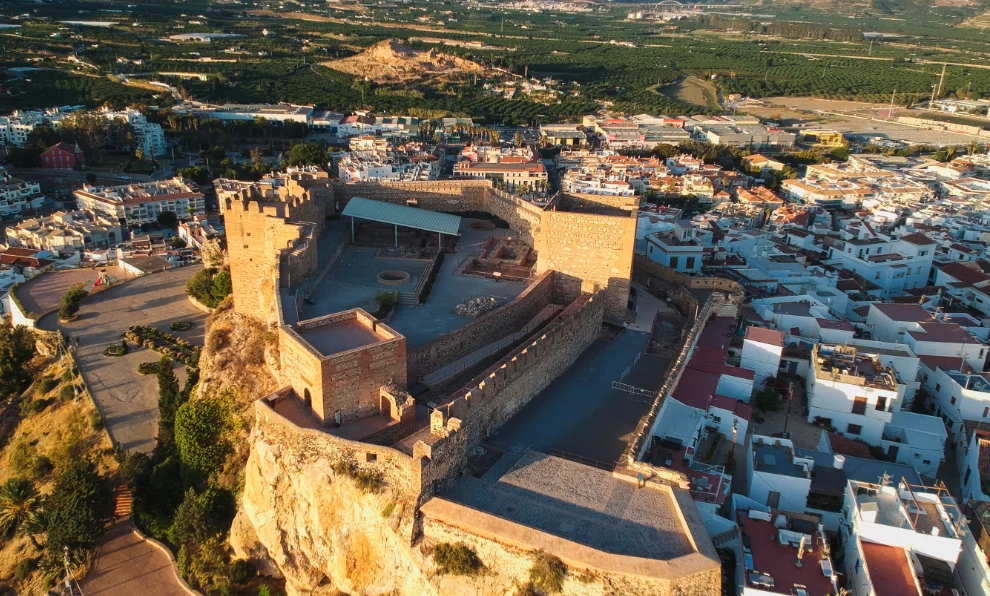
After the capture of Salobreña by the Catholic Monarchs in 1489, the castle was adapted to new military techniques. The engineer and master artilleryman Ramiro López was responsible for designing the works that led to an artillery barrier facing the town. Throughout the 16th to 18th centuries, the fortress continued to be transformed to incorporate defensive improvements.
At the end of the 18th century, sediments from the Guadalfeo River formed a delta that moved the sea away from the promontory, reducing the castle’s effectiveness as a coastal defense. Gradually abandoned, it entered a long period of deterioration.
The recovery of the castle began in the 20th century. Following the Decree of April 22, 1949, which protected Spanish castles, the first restoration projects were drafted under the direction of the architect Francisco Prieto-Moreno. Missing stretches of wall were consolidated, the facades of towers such as the Old Tower were rebuilt, and damaged structures were reinforced.
During the final decades of the 20th century, the castle was the setting for cultural and musical activities. Platforms and tiered seating were built between the artillery barriers to host open-air performances. Today, events are held on the Paseo de las Flores, at the foot of the fortress, thus preserving its historical integrity.
Recent restoration work and archaeological excavations, led by the School of Arab Studies and the Salobreña Town Council, have made it possible to recover previously unseen areas and gain a better understanding of its architectural evolution.
Audioguía Oficial Castillo de Salobreña
The excavations focused on three sectors:
In Sector A, an old platform used as seating, remains of the Nasrid residence were discovered, with paving and walls from the medieval period.
In Sector B, opposite the Old Tower, underpinning work was carried out on the tower’s foundations, and an Andalusi cistern excavated in the 1950s and later filled in was found.
In Sector C, between the first and second artillery barriers, embrasures and 16th-century structures built by order of the Catholic Monarchs were uncovered. The excavated surface measured 443 m², with a variable depth between 50 cm and 2 meters.
The castle is organized into three main enclosures:
- Inner enclosure or Nasrid alcázar, the oldest core, with towers such as the Keep, the Old Tower, the New Tower, and the Powder Magazine Tower.
- Artillery barrier enclosure, added during the Christian period to strengthen defense against new firearms.
- Coracha enclosure, a system that protected access to water through the Cistern Bastion, the Water Tower, and the Coracha Tower.
Its architectural highlights include the outer access gate, the artillery bastion, the Cistern Bastion, the gate to the inner enclosure, the Coracha Bastion, and the Water Tower. From the upper enclosure, the views extend across the whole municipality, the sea, and the mountains.
Today, the castle is immersed in an ongoing process of conservation and enhancement, with the aim of consolidating its structure, recovering the Nasrid royal residence, and offering visitors an experience that combines heritage, landscape, and culture.